With their noses angled up like little speed boats, the turtles of Wade Park plow a clear wake through thick green water that closes immediately behind them. They hustle towards us when they hear the creak of our footsteps on the bridge slats. Then they slow down, perhaps they remember we’re stingy with the handouts; they coast under the bridge on the fumes of their initial enthusiasm. I feel an unexpected nostalgia for the addicts that lurked in the park near our old Boston apartment, how they learned to stop asking us for change and my kids learned to say hi to them.
One has a plastic bottle cap stuck to its shell.
The cap is green, likely from a quart of milk or orange juice; the turtle is of a greenish variety.
Not sure of its name. Not gonna look it up.
That’s because I have decided to write about my relationship to my son and nature in [gestures broadly] this place, E.L. Wade Park, Wilmington, North Carolina, without looking anything up on the internet. No Googlin’! I hope these epistemological guardrails render a wilderness from this tiny stamp of swamp, and help me confer, onto the page, the naturally-occurring wonder and humility one feels in the presence of truly feral and spectacular things, such as turtles.
So I promise myself that I will study the turtles here and write about them for the whole first semester of my MFA program here at UNCW, a pretty long longitudinal study for someone so flighty. I begin with one and then consume all the 14 informational signs posted in the park. Eight of them occur in pairs (one tells you how hazardous the water is, and the other begs you not to feed the turtles), two ask you to scoop your own poop (with a picture of a dog, thankfully), two describe the wildlife you can see, and there are two maps. If I can’t figure out something (say, the size of this 17-acre wetland or its function within the upper Hewlett’s Creek watershed) from these signs, I’ll be forced to ask somebody.
It seems like a Luddite, technophobic thing to do, but the blush of risk attached to personal interaction in this Age of Covid transforms turtle walks with my toddler into a daring adventure.
After a few trips I commit some observations to paper.
The turtles take turns sunning (or possibly loitering) on a plate-sized island of grass. Based on the amount of time spent here per sunning session and the quick turnover rate between users I deduce that it’s prime real estate. I am surprised whenever I see a smaller turtle here, and impose upon the larger, patient, water-treading turtles waiting their turn a kind of benign patience that speaks to a rich inner reptilian life beyond my comprehension.
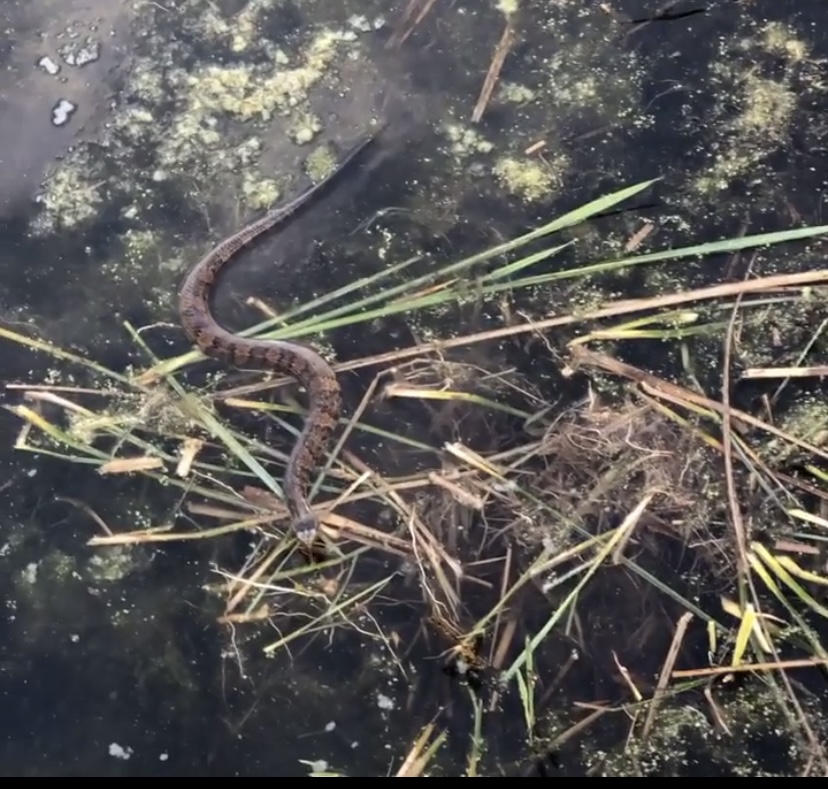
There are water moccasins. For every one you can see there are a dozen false alarm double-takes. Swirls, splashes, tricks of light and the imagination make moccasins of it all. The first one was seen by Isabel and the kids, who came from a walk back to tell me about it breathlessly. Two in one day! Ollie is walking now, so when we put him down in the exact middle of the bridge and we have about ten seconds to catch up to him before he reaches the tall grass on either end. He’s a small mammal, and according to the snake information on a nearby informational sign, food.
I have wrapped my head around the general size range of these turtles, but today the algae cleared, and a new species blew my mind. Max was standing on the steel bridge cables, hanging half his torso over the water. Lucy was singing. Ollie was trying to get a rise out of me by sticking his foot under the bottom railing, making an uh-uh-uh noise, and pretending to knock his croc off.
Max pointed, “Look at that big one.”
I humored him, pretended to see it. Then, like one of those magic eye posters, I let my eyes un-focus; I saw past the surface reflections and gasped at the monster on the bottom. All the other turtles swimming over the alligator snapping turtle, with their high noses sniffing out junk food, seemed like satellites crossing the vast and cratered surface of a strange planet. Its head was the size of my fist, its shell the size of a lunch tray. The spikes over its eyes descended straight from dragons.
I might have crossed paths with a bigger one thirty-five years ago. On a morning ride to middle school there was huge snapping turtle blocking the gravel road. My mom put the car in park, got out, and cajoled it onto the shoulder with a tree branch while my sister and I watched through the windshield, like an action movie. Adjusting for time and nostalgia, this one at Wade Park was likely bigger, definitely an order of magnitude larger than the little guys that took turns bumping into it and then sunning over on their favorite patch of grass.
Was that an ibis? How late in the year are snakes active? What does that graffiti on the wall say? With questions mounting, Google grows tempting. I want to know the names. But I don’t need them. I’m enjoying the ride, without labels, like going to a concert without knowing the words to the songs.
I’m reminded of my first experiences at Grateful Dead shows, before I knew the names of songs and just observed them all with the unsullied awe of a caveman staring at the cosmos.
I’m also reminded of the joy of recognizing a constellation and greeting it by name and the surprising sorrow the time I wished upon a star that ended up being a planet.
Saturn has been wooing Jupiter across the sky lately, flirting closer since the start of the pandemic, a celestial sprint in geologic time. Mars rises red at dusk and Venus is the last one still up in the morning. Orion takes a while to grace the sky, fashionably late after night is well underway.
I would know little of this had I not feasted my eyeballs on the Night Sky app shortly before my self-imposed fatwah against googling. But I tracked their movements organically from then on, like a punter watching his horses at the racetrack.
I am beginning to reconsider the desirability of this turtle-baiting patch of swamp grass. Lately there has been almost no competition for it, and puny-looking turtles get the run of it for extended periods of sunning. Perhaps it has become unfashionable or succumbed to rising water levels. Maybe it’s a pariah zone, like a homeless camp under an overpass. This idea is distasteful because it seems unfavorable to both the homeless and the turtles.
Maybe it’s a nursery.
The signs clearly say don’t feed the animals, so anyone doing this in their shadow sins doubly, both injures the wildlife and insults the messaging (with which I’ve got a blossoming relationship.) I see an entire family breaking the rule: a whole garbage bag of crouton-looking pieces, reeds choked with them, turtles gorging. In one version of this scenario I march over, exchange terse hellos, ask if they’ve seen the sign, acknowledge how fun it is to feed wild animals with your kids, and then pivot towards admonition and suggest that if they truly love the turtles (as we all do), then they should really stop feeding the fucking things, per the sign. But I don’t say anything. It’s not that I’m a coward, I just have a rule when it comes to conflict: treat all people like they are Dwayne “The Rock” Johnson.
Since I wouldn’t, in all honesty, march over to The Rock while he’s feeding the turtles and ask him if he can read, I continue biking past this crumby family without visible incident, just an imperceptible dimming in my soul of the general love I have for humankind. I need to find a way to broach the subject with this theoretical The Rock so that I can talk with families like this without being confrontational. A check of my pulse reveals I’m not there yet.
I bike across the bridge, even though the sign said walk your bike. Apparently I’m selective about what rules I follow. Typical. But one of them does seem way more important, and the other one… more like a suggestion.
After September, summer’s traces grow sparse. The green bottlecap’s still there on the shell. The red McNuggets box by the reeds is finally sinking.
Overcast, October. Turtles huddle mostly underwater, like we did on our last trip to the windy beach. The odd turtle head leaves a trail through green stuff that looks like a sidewinder and then self-erases.
Then a real snake appears. I hold Ollie tighter; he tries to throw himself in the water and the snake tests the air for frogs. Then we notice something by the reeds. It’s an inner tube; it’s pork loin; it’s bull kept — oh my God, it’s a fucking eel. It’s oily, unmoving. The skin looks cracked and vulnerable, half-sunk into the muck, and we wait for signs of life that never come.
Behold, the power of discovery! I learn something new today without the internet. A guy on the bridge says there are otters here. A mated pair, he says, active at dusk and dawn. I fight the urge to tell him the word, “crepuscular.” I tell him about the snapping turtle and the eel and he doesn’t really believe me. So I don’t believe him.
Fuck his imaginary otters.
We bring another family here and I notice we try to sell them on our park. Our kids become docents and tour guides and despite not appearing to listen to us, they are basically following a script we didn’t know we had, and we shudder in tandem at how we must sound when parenting.
Suns out, guns out, gotta love these hot October days. I’ve even rolled up my t-shirt sleeves to avoid a farmer tan. Turtles are sunbathing on the cement partition in the middle of the water. Two of them appear to be frozen mid-leapfrog, stacked on each other, arms and legs stuck stiffly outward. Ollie wants to keep going, but I’m drawn to this tableau, where I am reminded of two people tripping too hard at the setbreak of a concert and trying to act normal once the house lights turn on.
It’s overcast again. Late October, but almost eighty degrees. Jays screech. Then a new bird chimes in, unseen but loud, and I record video, shitty video, of a scraggy tree blasting birdsong.
I play it back later, sleuthing at home with the littlest. We are surrounded by the bird books, used books from faraway libraries whose stamps read like old passports. Sioux City public library? How the f did it get here? Each book has buttons to press, and you can hear a recording of the bird played out of a tiny speaker in the page. They are cardboard pages, which is why they still exist, and why Ollie hasn’t ripped them. He soon loses interest in the research, and I play the video for the older kids when they get home from school and see what bird they think it is. We run through all the easy ones that it isn’t (turkey, owl, loon) until we hear the jay and agree unanimously that’s the culprit on the video.
There were so many monarch butterflies just a few days ago! Now, there are none and there’s no rewinding. I fear that I did not fully appreciate them when they were here, and now I’m in one of nature’s vacuums and I abhor it. I’m like a bear that missed the year’s salmon run, hungry for something that was just here.
The rectangles of our Wilmington suburb are separated from the blob-shape of Wade Park by three well-defined thresholds. Each entrance has an almost elegant wooden bridge, not unlike pre-Cortez Mexico City with its causeways, which makes me think that the center has to protect itself from outsiders, us.
The first step into the park just smells different. The water running under the bridge usually has at least one bottle littered in it, so my first instinct is to think the pine forest smell is coming from a car air freshener or something equally artificial…but it’s not. I know it’s not. That pine smell is the pines, man.
Green plastic cap floats like a photoshopped spot on the water. Small turtles act characteristically immodest about their sunbathing: two are planking on top of each other in awkward and elegant balance.
I’m biking around a bend when suddenly there’s a crime scene on the pavement. Grisly bird feathers become a chalk outline. A recent predation. Then a closer look. All the “feathers” were green. This ambush was vegan. I dismount and inspect. Somebody had deflowered a tree branch — leaves plucked everywhere, net zero ballots cast for he loves me, he loves me not.
We see one last monarch butterfly on the way to the park. You lost, amigo?
Today feels like fall. Yesterday I could hear the shrieks of joy from neighborhood swimming pools. Not today. At Wade Park I spook an egret and we watch it re-settle at the next bend. Ollie breathes softly in my ear while we watch it hunting.
It leads with the tip of its beak. When it whips around to look at us, it’s hard to see head-on, like a single point in space. When it whips back to hunt, we are offered a stunning, gorgeous profile. Then another step, beak-first, whole neck extended. Then, like an inchworm, feet move body forward, body catches up, and it’s coiled again. In this way the tip of it scouts, the rest of it prepares, and when the body catches up, it’s spring-loaded.
It stabs the water. The beak emerges dripping with a small fish, open a minute angle, like chopsticks holding a pea. I silently implore Ollie to be quiet but there’s no need: he’s riveted. He only yells when the bird flies away. An attention-getting grunt that turns some walkers’ heads toward us but has no effect on the egret.
When we arrive at the turtle bridge our friends are hidden. After yesterday’s rain there’s an oil slick rainbow on the surface. Like images from a dream or possibly a Polaroid, forms take shape underwater. Ollie sees them, too. Squeals. More come. He presses his forehead against the steel bridge cables. A walker comes by, stands too close, tells me there’s a hawk in the tree over there. I tell her thanks for the heads-up. I mention our bird book at home, and say I sometimes record video of this place so my kids can ID the bird calls when we get home.
She says the red-winged blackbirds should be coming soon.
I’m so excited I almost recite my version of their call I learned from the bird book. It’s long note followed by, essentially, a cell phone ring. I spare her. I keep an eye out. I ask if she’s from Boston and she puts her hand on her forehead like she just remembered she’s wearing a Red Sox hat.
“Oh, I’m from Maine!”
Ha, close enough.
We talk seasons for a second and then Ollie and I are alone again with the turtles.
This is our first trip since the November cold spell.
Algae is just a memory and the water’s clear to the bottom.
Someone has cast rose petals into the water, and I bounce between admiring their beauty and wondering if they’re hurting the environment. Some of them sink, waterlogged.
The red winged blackbird! It’s the weekend, so all three kids are here to hear it. Heads swivel. Lucy counts them. “Lots.” The book comes to life.
Max says he thought they would be bigger.
I fish a girl’s water bottle out of the muck with a branch. The mom had given up on it, but with all the reality TV survival showsI’ve been watching, I know a thing or two about improvising, adapting, overcoming. The mom thanks me but the girl eyes the green strings of algae hanging off it. On a roll, I keep going and fish out another one, a blue plastic bastard I’ve been eyeing for months. I’m reeling with good deeds. I check my watch and yelp in pain when I realize I’m already late for a Zoom meeting. We fly across the footbridge bridge where eighth graders hush each other and vape underneath like trolls-in-training.
Warm, grey November. A few noses break the perfect plane of the surface and then sink back down, disappointed in us. The most exciting wildlife is a turkey vulture wobbling on updrafts.
A mated pair of ducks tips upside down to feed, curly tail feathers dripping, orange feet braced on the surface, then gets their bearings behind a screen of reeds. It’s a slow day on the water. I know there’s a snapping turtle lurking down there somewhere. Today would be a good day to see it again, but I can feel it’s not happening. On the other side of the bridge the turtles appear and Ollie squeals. They’re suspended in water like the baby on that Nirvana album cover. One sculls towards us, dishing T-Rex hi-fives out to its homies along the way.
Today I stayed at home, and when Isabel and the kids get back from turtle park I can tell there’s been a conflict. Max bursts into the room where I’m typing and tells me about the man feeding the turtles with his grandkids. Max was the only one who said anything to him, bless his autistic little heart. He is the kid who, for example, wonders aloud in grocery stores why people aren’t wearing masks. Today he asked the grandpa not to feed the turtles. By interpolating the snippets of story from him and Lucy, I don’t think the grandpa actually heard them
I fantasize about a nice passive-aggressive sign I could leave at these people’s house, knowing I would likely invoke The Rock rule and not say anything to his actual face. I muse aloud that the pieces of their shitty Wonder Bread (I’m sure it’s shitty Wonder bread somehow) are going to go uneaten and still be floating there like the other trash that sits there until it gets waterlogged, sinks and turns into petroleum for whomever comes after us humans and likely won’t even use fossil fuels. Trash like the red nuggets container, brown tennis ball, and Trojan Magnum condom wrapper, which glints like fools gold against the tea-colored bottom. The condom itself shrivels and coils behind the park bench like ghostly snake skin.
Max corrects me and says it wasn’t bread, it was Honey Nut Cheerios. He would know.
There’s a lull in the beginning of my next Zoom class while people log on, so I mentally scaffold yesterday’s turtle news onto the plot graph of an interesting story and cue it up just in case this silence continues for another few seconds. It does. So I tell the class about this park near my house. Those who have been paying attention will remember it from other anecdotes, but I speed through the backstory anyway: it’s called Wade Park, it’s a little wilderness in our suburb, it’s got turtles, I ride through it daily with Number Three, it’s essentially an open sewer, a place where runoff gets filtered by the wetlands on its way through the watershed towards—
Before I get to the good part, the professor cuts me off.
“That ‘sewer’ is the headwater for the creek I live on!”
Hard to tell with everyone’s mics muted, but I think I see some laughter.
“Didn’t mean to diss your watershed,” I added lamely.
He starts explaining something to the class, but all I can think about is allegiance, and how touchy a person can get if you insult their home sports team.
It seems predictable that he got a little huffy. Anyway, his reaction was better than the story I was going to tell, something about a turtle.
Ollie and I notice a new kind of turtle. We agree it’s a different species, with a distinctive red neck. As I think of those last two words, the unremarkable phenomenon of a green light on South College Road inspires a thunderous car race that roars and dies by the next light. In a snarky moment I connect the red necks across time and space.
Ollie goes to pet a new dog. I hate getting close to the owner — germs — but what can you do? “What’s his name?” I ask, still sizing up the little thing and ready to pry it off my son’s face, should the need arise.
The owner doesn’t hear me, comments on the nice weather we’re having.
Today is different. Different birds. A new one with a red-orange chest. Maybe it’s a robin. Seems fancier than my recollection of a robin. Can’t look it up, though. Of course, there are more red winged blackbirds. Wrestling Ollie back into his bike seat we look up and see a billion-strong flock of something contorting into mobius loops over our heads. The bird-cloud disappears behind a distant row of trees and when I shut my eyes and try to follow the susurration with my ears the cloud sounds come from everywhere and nowhere. Omnidirectional swirling like wood smoke.
The turtles are laying low today. A bright thing in the water makes me mad. Another damn bottle cap. No, it’s a turtle head! I wonder why I didn’t recognize it at first. I see its bright red eyes glowing at me from underwater. Are those snake eyes? Impossible. After a few seconds of hard staring through cold water that shimmers like a heat mirage, I decide it’s only trash.
Biking back to our other life I see another last monarch butterfly of the season.
I’ve got Ollie strapped to my torso like a suicide bomber and we’re doing our second park trip of the day because he wouldn’t go down for his afternoon nap. See, he threw Blue Monkey into the toilet earlier. And without Blue Monkey, napping is out of the question. The lovey was midway through a spin cycle when we left, which Ollie took with some difficulty, throwing himself on the ground and writhing in the kind of agony usually reserved for highlights of war movies.
It is only two o’clock, but the low angle of the sun hits him right in the face. My hand shades his eyes, like he’s looking for gold faraway hills. Stepping into the park I smell that strong pine air freshener and I notice how walking through here is much different than biking. I don’t think I’ve ever just walked through here. Biked, skateboarded, chased a kid on a bike…
Now here I am, ready to receive nature at its pace, In shaa Allah. Like a sign, a tiny spinning seed appears against the blue sky in front of me and without changing my pace I hold out my left hand and it lands like a delicate helicopter in my palm. We walk across the bridge, notice how clear the water is, notice that the red eyes from earlier were simply reflectors on a submerged bike tire, stuck like a table saw blade upright in the deep muck. My plan is to return home with the seed as evidence of some minor miracle and spin it into a story for the kids when they get home from school.
My plan changes when I open my sweaty palm to check on it, and a puff of wind from the west sends it on the last leg of its journey to the ground.
Coldest day yet. The baby is making sleepy noises behind me as I bike with one hand, the other one stuffed into my thin jacket. They take turns warming up. His hands are tucked inside his folded-over jacket sleeve, and I can’t tell if this is cruel or kind, trading dexterity for warmth. His moaning gets drowsier, louder, and I pedal faster, crazier in hopes of rousing him. I lean the bike against the bridge railing and chuckle when I go to unbuckle him. The helmet has slid down over his face and he’s awake, has lined up a big green eye to look at me through a head ventilation slot.
I extract him from the bike and the helmet form him and set him on the bridge. He takes off running and immediately falls. He’s trying to push himself up, but his hands are tucked into his jacket. When I pick him up there’s a slobber mark on the unfinished wood and an abrasion on his forehead. A small woodchip on his lip. When I hold him tight and lean against the top railing to look for turtles he immediately stops crying. This is the first time we don’t see a single turtle. I look on the other side of the bridge where they usually sun themselves. Nothing. Overhead a few vultures wobble. That’s it. I stuff him back into the seat and try to tighten the helmet.
The wind works against us on the way home, and I recall a scene from James Galvin’s book The Meadow: a waylaid frontier family trudges home through a blizzard and the seemingly cruel dad has to repeatedly kick his sickly son to keep him from falling asleep and dying. Unsure if I possess that breed of paternal strength, I play to my strengths and pedal faster. On a long enough timeline, we won’t make it out of these burbs alive. It’s three blocks home, forty degrees in the sunshine, and a 20-knot headwind: at this rate we’ve only got a few hours.
We’re home in five minutes. I whip off his shoes and throw on the kettle. Within a minute Ollie has fallen down again, and I’m wiping the blood off his gums when the water finally boils.
Ollie and I are at the exact spot on the bridge where we witnessed a spanking yesterday. A bicycle gang of teenagers had buzzed too fast and too close to our precious children, whose bodies and bikes and scooters were strewn across the breadth of the bridge. Isabel might have yelled for them to slow down or get off their bikes — the content is almost irrelevant. When he heard her chastising tone, the surliest teenager lifted his right butt cheek off his bike seat and smacked it in her general direction. The combined effect of his Bluetooth speaker playing trap music, his Trump sweatshirt and the rude gesture sent an angry growl from her that sizzled like a hot pan in the sink. I half-respected the commitment of the little shit. There should be a monument here, to her indignation.
A phone call from Isabel intrudes upon today’s amateur bird watching, and before the content of the words sinks in I hear the tenor of her voice, and my thoughts return to that cheeky boy.
“I just got into it with a fucking guy at the Post Office.”
Hi.
My adrenaline sings and my frontal cortex processes slowly, paralyzed by my unglued animal brain throwing itself around its amygdala cage. Details of the conflict in the Post Office filter through in digestible bullet points.
She asked the guy working there why he wasn’t wearing a mask.
He tapped the glass.
She pointed to the big gap underneath it where packages and germs could slide through.
He rolled his eyes.
His masked coworker piped up, reminding him that they have a sign on the door saying everyone has to wear one.
He tapped the glass again.
I do my best to keep Ollie from falling in the swamp while I’m registering this information. I keep up my end of the conversation with encouraging grunts and sighs of commiseration. I know she probably helped escalate the situation, but a pure rage surges in me, here, as if prepping my DNA to fight him. When I picture him, he’s got a naked and very punchable nose.
Let me tell you a little story about unwanted views of appendages. One time I knocked on a friend’s bedroom door in college. I waited a second, then opened it to get something. What I saw next is what I think of whenever I see somebody out in public these days, like you, with their nose and mouth just wagging unmasked in the breeze. I saw my friend running naked towards the door with sheer panic on his face, his girlfriend behind him in the dark, and his boinging erection leading the way, gesticulating at me like a tacky hood ornament, a white dowsing rod breaching utter blackness.
That flash of non-consensual intimacy is what I think about peeking between the cattails with Oliver, looking for ducks and only seeing the Post Office man’s stupid, stupid nose.
It has been slow in the turtle world lately, hard to remember a time that they used to swim up to the bridge like pigeons descending on a bread-packing old lady. I hype up the kids when I see what looks like an alligator snout. I hold Ollie tightly while he sits on the edge and dangles his shoes over water that would gladly swallow them whole. I strain reaching my hand into the pocket of my jeans, aware that they feel weird after so many months in shorts, and pull out my phone.
I film this alligator snout for later and congratulate myself on having captured the image without children or shoes falling in. I notice another snout, and another. Just when I’m thinking that the balance of nature has generously replaced turtle with gator, I realize what they are. Recent rains have dislodged clumps of vegetation and these floating root balls are what I’ve been mistaking for reptile noses. Honest mistake.
When we’re warming up back home in the kitchen, taking materials out of the fridge and cranking up the gears of the lunch-industrial complex, I hear Ollie’s familiar uh-uh.
I ignore it at first and then remember how this has ended in the past.
There was an uh-uh before he threw his lovey in the toilet. There was an uh-uh and a splash when he threw mom’s phone in there, too. A bag of popcorn dumped on the ground, a ceramic frog launched off the porch, a marker stuffed into the mouth: all telegraphed, like the approach of a movie shark, by a two-note harbinger.
I’m bent over a half-made turkey sandwich when uh-uh lands like a dewdrop on a fuzzy leaf, takes a second to bead up and soak into my awareness. A second later I drop the knife with a clang and rush over to where he’s standing by the window.
It’s a fly.
Despite steering him towards birds and dogs and turtles, his favorite animal is absolutely the fly. “Dog” was his first word: spoken with two syllables that sound a lot like “dada.” Maybe he lumps us together? Turtles, when they used to flock to him on the bridge, were dubbed “DAda,” like his word for dog with a hard stress on the first syllable. Everything else is a “gock.” Birds, squirrels and Halloween decorations? All gocks.
But flies are “buhs,” and they’re accompanied by a wild hand gesture that looks uncannily like a Midwesterner hailing a cab in Manhattan. They’re his favorite food, too, and it’s a memory of him walking up to me on another day, after I had ignored a similar string of uh-uhs, that sends me scurrying to where he is now.
Unlike that day, the fly is not hanging from his wet smile by a wing. Today it’s banging a sluggish rhythm against the cold glass of the window.
Ollie looks up at me, explains that it’s a “bah,” and does the fly hand gesture with infinitely more gusto than the fly’s own piteous late-season death throes. The sign language for this decrepit specimen could have been a pantomime of someone filling in an SAT bubble with a pencil. I’m tempted to take a tissue and end it, but he’s more excited about this fly than anything else today. Possibly ever. He’s pointing and squealing and doing a good impersonation of me showing him a turtle or fake alligator snout.
I remember the scene of catching flies with chopsticks from the movie Karate Kid, and decide that this fly is pretty safe from him. In the next second he mashes it against the glass with a single strategic jab of his wet finger, and neither of us can believe it.
“You beginner luck,” I quote from the same movie, and wipe the smooshed guts off his hand a second before he sticks it in his mouth.

